
Table of Contents
Introduction
Mental strength is equally valuable as physical strength, but it usually takes a back seat until we are emotionally tired. Those with Borderline Personality Disorder (BPD) experience fluctuating emotions, unstable relationships, and frequent mood changes. These moods can make life tiresome. One of the easiest methods of achieving emotional balance and mental clarity is surprisingly found in leg exercises.
Leg workouts are not merely body-building routines. They condition the mind to remain stable, concentrated, and disciplined. Repetitive action, strength use, and endorphin release condition you to cope with stress, stabilize mood, and gain confidence. Routine lower body exercise has been proven to enhance serotonin levels — the very same “happiness chemical” that numerous antidepressants aim to target.
This article investigates how leg exercises can assist you in conquering the emotional battles associated with BPD and enhancing general mental well-being. You’ll also learn seven strong leg exercises that build your body and mind.
1. Learning the Mind-Body Connection
Your body and brain are intimately related. How you move your body can influence how you are emotionally. Research indicates that exercise, particularly leg exercise, boosts blood flow to the brain, enhancing concentration, alertness, and emotional regulation.
When you do leg exercises, your major muscle groups require more oxygen, which causes improved circulation. This exercise causes endorphin release — natural painkillers and stress relievers. For people suffering from Borderline Personality Disorder, this eases irritability, anxiety, and emotion-driven outbursts.
Exercise also encourages the development of new brain cells in regions that manage emotion and memory. What that means is regular leg exercises can actually change how your brain processes stress and emotional issues. It’s not merely a matter of appearing fit — it’s about cultivating inner strength.
2. Why Leg Workouts Are Powerful for Mental Health
Most do not realize how much the leg exercises can affect the mental health. Legs hold some of the strongest muscles in the body — quadriceps, hamstrings, and glutes. They need energy, coordination, and focus to train them. All this intense activity automatically diverts your mind from misery and sadness.
The following are the reasons why leg exercises are important for your mental health:
- Better blood flow: Enhanced oxygen supply makes the brain work more effectively.
- Boosted serotonin and dopamine: These “feel-good” hormones manage mood and alleviate depression.
- Improved self-esteem: Noticing progress in your body boosts confidence and self-esteem.
- Decreased anxiety: Concentrating on movement keeps you present, with less room for anxiety to creep in.
For individuals with BPD, these payoffs mean fewer emotional tantrums, better mood regulation, and greater impulse management. As you challenge your legs, you’re also conditioning your mind to remain earthed and focused.
3. 7 Powerful Leg Workouts to Defeat Borderline Personality Struggles
1. Squats – The Foundation of Strength
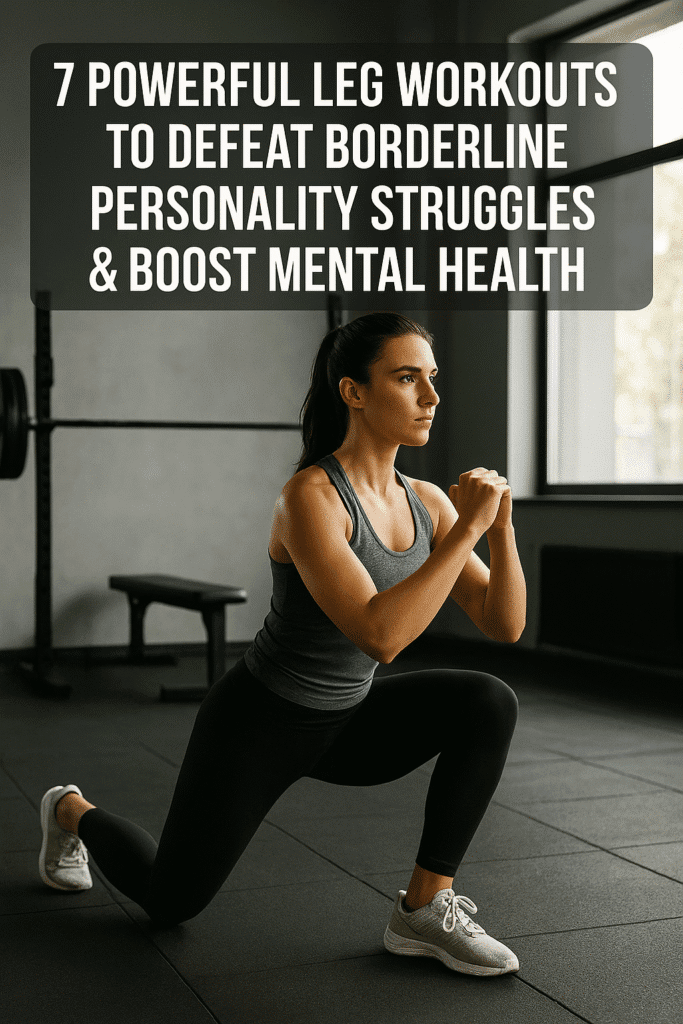
Leg workouts often begin with squats because they target all major lower-body muscles. Squats improve balance, posture, and endurance.
How to do it:
- Stand with feet shoulder-width apart.
- Keep your chest up and lower yourself as if sitting on an invisible chair.
- Push through your heels to stand back up.
Mental Health Benefit: Squats represent stability. Every rep puts you in mind of your strength to stand again, even in times of emotional lows. Regular squatting serves to direct negative energy into something useful.
2. Lunges – Balance Your Body and Mind
Lunges instill balance — both physical and mental. When doing lunges, the body has to be able to coordinate several muscles, which demands total concentration.
- How to do it
- Stand, step one leg forward, and bend until both knees bend into 90-degree angles.
- Push back up and turn over.
Mental Health Benefit: Lunges reflect emotional equilibrium. They improve concentration and patience, which are necessary for individuals coping with Borderline Personality Disorder symptoms.
3. Leg Press – Harness Your Inner Power
Leg press equipment develops lower body strength securely and efficiently. It enables you to regulate resistance, which assists in monitoring progress over time.
How to do it:
- Sit on the machine with your back against the pad.
- Push the platform up with your feet until your legs are straight.
- Slowly come back to the starting position.
Mental Health Benefit: The leg press allows you “push through” mental obstacles. It reminds you that you are in control of your effort — a helpful lesson for dealing with emotional triggers.
4. Step-Ups – Build Confidence Step by Step
Step-ups enhance muscle tone, heart health, and coordination. You can do them on a strong bench or step.
How to do them:
- Step one foot on the bench, push through your heel, and bring up the other foot.
- Step down and repeat.
Mental Health Benefit: Each step-up is a symbol of forward movement. For individuals with BPD, small steps like these can symbolize growth, patience, and moving forward from emotional defeat.
5. Calf Raises – Ground-Up Strength
Calf raises are easy but effective leg exercises. They build strength in your calves and ankles, leading to better posture and stability.
How to do it:
- Stand with feet shoulder-width apart.
- Slowly lift heels off ground, hold, then drop back down.
Mental Health Benefit: Calf raises are a lesson in control and awareness. They remind you, gently, that small, consistent habits can really raise your game.
6. Deadlifts – Letting Go of Emotional Weight
Deadlifts build total-body power, especially in your hamstrings, glutes, and lower back.
How to do it:
- Stand with feet shoulder-width apart, barbell in front of you.
- Bend at hips and knees, grip the bar, and lift it while keeping your back straight.
- Lower it down slowly.
Mental Health Benefit: Deadlifts are like life itself — lifting your load and releasing it. Deadlifts increase mental resilience, reminding us that advancement often begins by doing what feels heavy.

7. Wall Sits – Remaining Calm Under Pressure
Wall sits seem simple but test your patience and stamina.
How to do it:
- Stand with your back against a wall, slide down till your knees reach 90 degrees.
- Sustain the posture for as long as possible.
Mental Health Benefit: Wall sits reinforce calmness. They build your capacity to remain patient in distressfulness — a skill absolutely essential for coping with emotional chaos associated with Borderline Personality Disorder.
4. Uniting Leg Workouts and Mindfulness
To reap the most mental rewards, combine mindfulness with your leg training. Take a few deep breaths before commencing. Pay attention to how your body’s moving with each motion. Don’t hurriedly do reps; rather, pay attention to the rhythm of your breathing and the feeling of your muscles contracting.
This mindful method makes exercise a moving meditation. It calms nervous energy and keeps you present — a great benefit for those who get caught up in overthinking or emotional overwhelm.
Creating a Weekly Leg Workout Routine
Consistency is more important than intensity. Here is an example of a weekly routine:
- Monday: Squats, Lunges, Calf Raises
- Wednesday: Leg Press, Step-Ups
- Friday: Deadlifts, Wall Sits
Rest between sets and have at least one rest day between leg days. Your legs — and your mind — will become stronger, more balanced, and more resilient over time.
5. Diet and Hydration Tips for Improved Results
Your diet is important for physical and mental performance.
- Protein: Facilitates muscle repair (eggs, lentils, fish).
- Omega-3 fats: Enhance brain function (nuts, seeds, fish oil).
- Complex carbs: Keep you energized (brown rice, oats, quinoa).
- Magnesium & B-vitamins: Regulate mood.
- Drink lots of water before and after you exercise your legs. Hydration enhances concentration and decreases fatigue, keeping you motivated.
6. Conquering Motivation Obstacles
With Borderline Personality Disorder, motivation will change. Some days you’ll be unstoppable; others, standing up seems impossible. Here’s how to remain consistent:
- Small goals: Begin with brief periods; increase slowly.
- Monitor progress: Document workouts and moods.
- Reward yourself: Treat yourself for finishing a workout.
- Get support: Become a part of an online fitness or mental health forum.
Keep in mind that progress is not always linear. Even making it to your leg workouts on bad days is a victory.
7. Real-Life Stories and Inspiration
Healing has been found by many through fitness. One instance is a young lady diagnosed with BPD who mentioned how regular leg exercise assisted her in controlling emotional breakdowns due to the feeling of control and stability it provided. Another person claimed feeling more peaceful and confident after sticking to just 20 minutes of morning leg training.
These testimonials show that exercise isn’t merely physical — it’s a way to emotional healing.
8. Frequently Asked Questions (FAQ) on Leg Workouts and Mental Health
- How do Leg Workouts enhance mental health?
Leg Workouts improve circulation and oxygen to the brain, enhancing serotonin and dopamine — the mood-improving and anxiety-reducing hormones. They release endorphins that reduce emotional tension and stress, enhancing improved mental balance.
- Do Leg Workouts aid individuals with Borderline Personality Disorder?
Yes. Leg Workouts encourage discipline, organization, and regularity — all of which can assist those with Borderline Personality Disorder (BPD) in keeping emotions under control. The concentration necessary during exercise also promotes self-awareness and emotional regulation.
- How frequently should I perform Leg Workouts for mental health advantages?
For optimal results, try 3 sessions a week. This allows your body time to recover while being consistent. Even brief 20–30 minute sessions of Leg Workouts can significantly improve mood and energy.
- Are Leg Workouts appropriate for beginners with BPD or anxiety issues?
Yes. Beginners can begin with basic Leg Workouts such as squats, lunges, or step-ups. These workouts are equipment-free and can be performed at home. Perfection is not the target but rather progress and consistency.
- Which Leg Workouts are best for stress relief?
Squats, lunges, and wall sits are great for stress release. These Leg Workouts need concentration and bodily exertion that shift mental tension into action, letting your mind and body relax.
- Can Leg Workouts slow down overthinking or rapid thinking?
Yes. Leg Workouts demand concentration, coordination, and rhythm, which pull your attention away from overthinking. Over time, this focus helps train your brain to stay present instead of getting stuck in repetitive thought patterns.
- Do Leg Workouts improve self-confidence?
Absolutely. Periodic Leg Workouts tighten your lower half, correct posture, and leave you feeling more powerful. Physical changes inevitably translate into increased confidence and self-esteem, an important factor in getting well mentally.
- How do I maintain motivation to keep doing Leg Workouts?
Begin gradually, have realistic expectations, and monitor your progress. Motivation usually results from observing outcomes. Use your most favorite playlist or positive affirmations with your Leg Workouts to make sessions fun and significant.
- What is the connection between Leg Workouts and emotional stability?
When you perform Leg Workouts, your body emits endorphins that regulate mood swings. The regimen of having a workout routine also establishes a sense of control, which is crucial for emotional equilibrium.
- Can Leg Workouts enhance the quality of sleep?
Yes, they can. Physical activity through Leg Workouts brings down cortisol (the stress hormone) and calms your body. Improved sleep, in turn, enhances concentration, patience, and emotional control.
- Are Leg Workouts more effective than cardio for your mental well-being?
Both are effective, but Leg Workouts offer additional grounding effects. Strength training is what makes you feel stable, but cardio enhances your endurance. Having both together can generate the best possible effects for your body and mind.
- How can Leg Workouts aid mindfulness practice?
Mindfulness is being present. At Leg Workouts, pay attention to your breath, form, and muscle movement. This awareness redirects your focus away from emotional pain to body sensations, creating mental clarity.
- Is there a particular time of day optimal for Leg Workouts?
Morning Leg Workouts can boost your mood and energy for the day, while evening sessions help release built-up stress. Choose a time that fits your schedule — consistency matters more than timing.
- Can Leg Workouts help during emotional breakdowns or anger episodes?
Yes. When emotions become too much to handle, performing a quick session of Leg Workouts such as squats or wall sits redirects that energy in a positive manner. Physical activity reduces emotional intensity immediately and calms the mind.
- Do Leg Workouts involve gym equipment?
Not at all. Most Leg Workouts — including squats, lunges, and calf raises — are body-weight-based. If you do have access to weight or resistance bands, you can always add them later to ramp up challenge and strength.
- How do Leg Workouts promote self-control?
They instill patience and discipline. Standing on a wall sit or doing several squat sets conditions you to remain steady under stress. This psychological toughness is applied in actual situations where emotional self-control is required.
- Can Leg Workouts substitute therapy or medication for BPD?
No, Leg Workouts are not a substitute for therapy or drugs. But, yes, they can be an addition to therapy. Physical exercise improves emotional balance, making therapy work more effectively and enabling you to tackle stress in a better way.
- How will I know that Leg Workouts are helping my mental well-being?
You will realize improved mood stability, improved sleep, decreased irritability, and greater confidence. Regular Leg Workouts also leave you feeling calmer and in command of your emotions.
- In what way do Leg Workouts affect hormone balance?
Strength-based Leg Workouts induce testosterone and growth hormone release, enhancing energy and metabolism. More crucially, they stabilize cortisol (stress) levels so that you feel calmer and centered.
- What should I eat before and after Leg Workouts?
Prior to exercising, have light carbs (e.g., a banana or oats) to energize you. Following a workout, consume protein-based foods like eggs, lentils, or yogurt to aid muscles’ recovery. Nutrition aids in physical and emotional health.
- How do I pair therapy and Leg Workouts to achieve greater benefits?
Apply therapy to work on thoughts and emotions, and Leg Workouts to deal with physical tension. Exercise causes your body to work out emotions, making therapy more productive because both body and mind are harmonized.
- Do Leg Workouts reduce tiredness or fatigue?
Yes. Although Leg Workouts burn energy, they also enhance blood flow and oxygenation, resulting in you feeling more alert afterwards. With regular practice, stamina is developed so that daily activities become simpler and less exhausting.
- Are Leg Workouts suitable for introverts or individuals who prefer to be alone?
Yes. Most Leg Workouts are simple to do on your own, in your home, or in a private area. As an introvert, this means exercise is a quiet self-care experience that builds body and mind.
- How do I monitor progress in Leg Workouts for motivation?
Snap progress photos, count reps, or track how long you can sustain wall sits. Visual progress keeps you motivated. Feeling stronger in the body often reflects emotional growth as well.
- What is the greatest psychological advantage of performing frequent Leg Workouts?
Regular Leg Workouts instill toughness. Every workout conditions your mind to cope with pain, remain focused, and bounce back from adversity — traits that are crucial to emotional development and mental health.
Final Thoughts
Leg Workouts don’t only sculpt your legs; they remold your mind. For anyone suffering from Borderline Personality Disorder or emotional issues, these workouts induce stability, confidence boosts, and mood enhancement naturally. Keep in mind, each rep reminds you that you’re strong enough for growth, strength, and healing — workout by workout.

9. Conclusion
Leg exercises are more than just physical exercise; they’re a path towards mental endurance, stability, and confidence. For individuals suffering from Borderline Personality Disorder or overall emotional instability, leg exercises bring structure, discipline, and a feeling of accomplishment.
As you build your legs, you also build your mind. Each squat, lunge, and step represents your ability to cross obstacles. Begin small, remain committed, and see how your emotional well-being changes with your physical development.
Your path towards improved mental health can start with one easy transition — your initial leg workout.